Washington, If You’re Listening
CRCC Complaint Evidence Package
This is the evidence package for the CRCC complaint I filed that was shut down claiming I had failed to submit any evidence. The file was closed September 22, 2026.
The package shows the evidence, and even Public Safety Canada has said there is little to no evidence to support the claim that Canada is a major producer of fentanyl, yet the RCMP continue to say this, causing $200 billion in lost GDP.
Open the CRCC evidence package (PDF) →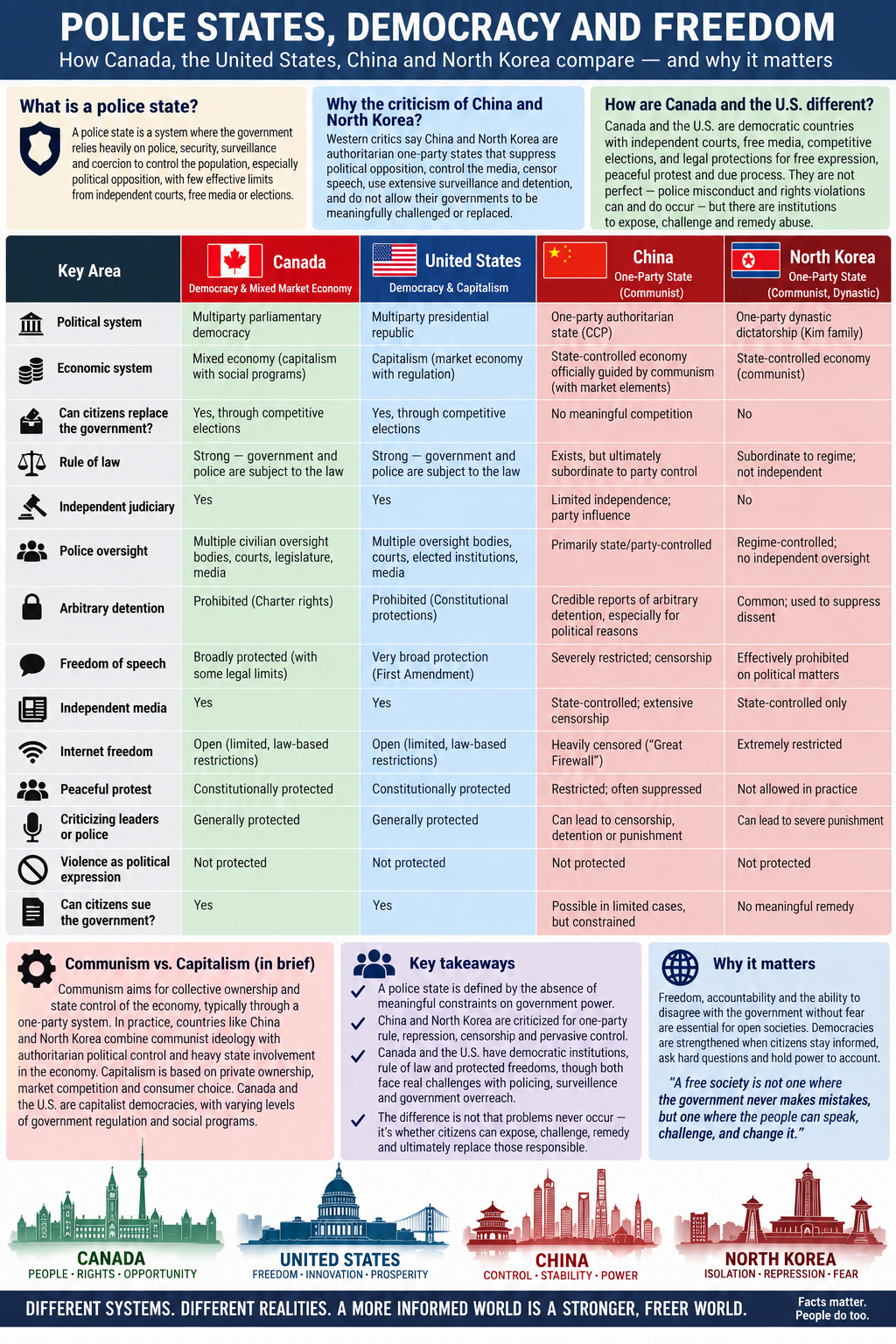
Questions About RCMP Complaint Oversight
I have serious questions about the way complaints against the RCMP are handled in Canada.
Many Canadians would reasonably assume that when they submit a complaint to the Civilian Review and Complaints Commission for the RCMP, an independent civilian body investigates it. That is generally not how the system works.
Under the RCMP Act, complaints received by the CRCC are normally sent back to the RCMP for the initial investigation. The Act also gives the RCMP Commissioner authority, in specified circumstances, to direct that an RCMP complaint investigation not begin or not continue. A complainant can then ask the independent CRCC to review what the RCMP did.
That structure deserves public scrutiny. Civilian oversight is most meaningful when the public can clearly understand who is investigating whom, who has authority to end an investigation, and what independent recourse exists when a complainant disagrees.
My own complaint has raised another concern. The CRCC advised me that it was closing its file because requested information had not been received. I have a record showing that I sent a response before the stated deadline. I have therefore asked the Commission to reconcile its records, associate my submission with the complaint and explain precisely what occurred.
I am not asking anyone to presume misconduct. I am asking for documentation, transparency and an accountable process.
This is bigger than any one complaint. Canadians should be able to understand exactly what happens when they complain about the national police force, and civilian oversight should be demonstrably independent at every stage where independence matters.
In my case, I do not have all the details needed to prove that something is wrong, but I believe there is ample evidence that something is amiss with all three of these issues: the GHB/Xanax date-rape narrative, the Falkland fentanyl “superlab” claims, and DULF. There are also unanswered questions involving Ken Sim, alleged election interference by China, and family ties to Bernard Chan.
So I plan to do what Trump did and make these issues more prominent in my talking points than swimming pools, because they raise questions that public institutions should have to answer.
We have freedom of expression in this country, and political expression receives strong constitutional protection. We pride ourselves on freedom, democracy, the rule of law, freedom of speech and freedom of association. Police and state actors do not get to silence or physically harm non-violent political opponents.
I have already been attacked in broad daylight at a public beach in Vancouver and had my home and campaign bus broken into with ID/keys/laptop stolen and VPD has made no effort to recover them, while Ken Sim has reportedly received extensive security protection. The RCMP, City Hall and VPD have not provided substantive responses to the emails in which I have raised these issues.
This election is about public safety and free speech, democracy and the values we want to uphold as Canadians. I believe Canada should align itself with democratic institutions, open government, freedom of expression and the rule of law.
I do not have all the details needed to prove that something is wrong, and that is why—just as Trump called on Russia to help find the missing emails—I am calling on the United States government to help resolve these unanswered questions.
ChatGPT Pro has helped me organize and analyze research that contributed to this framing. The interpretations and political positions on this website are mine, and AI-generated analysis is not independent verification of the allegations. But it is a valuable tool for an examination that does not have money or politics tainting the framing. Reference
Trump used the Obama birther controversy to put himself on the national stage as someone willing to challenge the president and force a response. That's what I am doing with this:
This election has a remarkably unusual personal element for me because, a few months ago, I received DNA results from 23nMe thatvconnect me to the Trump family. You can read the backstory and see the evidence I am relying on, including my own birth certificate, at TrumpII.ca. As Trump demanded Obama's birth certificate, I am now demanding that Trump produce his DNA to compare to my own.
I do not align with Trump on most political issues. However I think Trump deserves recognition for remaining active in the lives of his children across multiple marriages. I also believe his administration deserves credit for actions connected to the arrest of Ryan Wedding, an event that caused an immediate disruption to the cocysupply in Canada beyond any caused by RCMP in more than 30 yesrs despite repeated reports of seizures far greater than the one involving Wedding. Basic principles of supply and demand and their impact on price that have been well understood for 1000 years give cause to question how this could be possible. The wedding arrest cause a doubling of cocaine prices in Canada overnight yet repeated reports of seizures up to 5x as large in Canada have not. The price of cocaine has remained very stable and steadily decreased due to inflation and the loss of purchasing power for my entire life. I am studying this with chatgpt as part of a broader investigation into drug-supply disruption in Canada.
That investigation remains ongoing. I cannot yet say that there is a documented pattern of Canadian police staging large drug seizures. The Evidence Deck project is intended to test that hypothesis by comparing reported seizures, quantities, charges, laboratory evidence, market effects and independent reporting. The Wedding case is being used as one reference point because significant reporting came from U.S. authorities and media as well as Canadian sources.
I am also examining the Falkland “superlab” case, including the public claims made about it, the charges that followed, and the evidence that would be needed to determine whether the original public narrative was accurate, exaggerated or unsupported but there are many unanswered questions and inconsistencies that warrant a public inquiry and production of records that otherwise remain inaccessible.
These are questions that could benefit from independent investigation and cross-border evidence sharing. If U.S. agencies possess records relevant to any of these matters, I would like those records examined and, where lawful, made public so these matters can be resolved.
Look out for my Make Hastings Great Again campaign bus on the streets of Vancouver, because I am going to make a lot of noise calling for detox beds over involuntary care ones and providing solutions to reduce retail theft, solve the problem of homelessness and bring accountability, lower cost and better service to City Hall. I am running for mayor on a platform that includes practical municipal proposals as well as investigations into institutions and policies that I believe deserve greater scrutiny.
When it comes to people who may have profited from harmful or unlawful conduct in the pharmaceutical or illicit-drug economy, I support evidence-based investigation, due process and prosecution where the evidence supports charges. Big Pharma and public institutions should not be exempt from scrutiny simply because they are powerful.
Vote Scott Gilbert for Mayor of Vancouver on October 17 if this is the kind of political agenda you want represented at City Hall.
Freedom of Expression
Canadian Charter of Rights and Freedoms, section 2(b):
“freedom of thought, belief, opinion and expression, including freedom of the press and other media of communication.”
Justice Canada’s Charterpedia notes that the Supreme Court of Canada has described the connection between freedom of expression and the political process as “perhaps the linchpin” of section 2(b) protection.
Freedom of expression is broad, including substantial protection for political expression, but it remains subject to lawful limits that can be justified under section 1 of the Charter.